


Locally Led Adaptation & Resilience
The world is becoming a more turbulent place. Sudden shocks and slow-onset changes and stresses further erode the livelihoods of people living in poverty, undoing development gains made in the past.
To overcome these challenges, CARE aims to strengthen poor people’s resilience, which means their capacities to deal with shocks and stresses, manage risks, and transform their lives in response to new hazards and opportunities.
At CARE we believe that increasing resilience is not an outcome that can be achieved within a specific time frame, but an ongoing process, and that changing the system and addressing the root causes of vulnerabilities and inequities is key to support people of all gender, especially women, to move out of poverty and reduce their vulnerability.
According to the latest IPCC report, approximately 40% of the global population is now living with the harsh realities of climate change: high temperatures, drought, flooding, and other extreme weather and slow-onset climate events. The climate crisis acts as a threat multiplier, with far-reaching effects relating to conflict, economic justice, gender inequality, health, displacement and food security. Thus, CARE pays particular attention to strengthening climate resilience and supporting climate adaptation.

To achieve changes with and for the most vulnerable people who have emitted least, CARE’s promotes locally led adaptation, e.g. climate adaptation in which local communities, community-based organizations, citizen groups, local government, and local private sector entities at the lowest administrative structure are included as decision-makers in the interventions that affect them (WRI, 2021).
Since 2002, CARE has been very active supporting and shaping Community-Based Adaptation (CBA) which is one approach that have helped scaling locally led adaptation. CBA is a set of or body of climate change adaptation activities developed in partnership with at-risk communities, in order to promote local awareness of, and appropriate and sustainable solutions to, current and future climatic conditions (CARE, 2014).
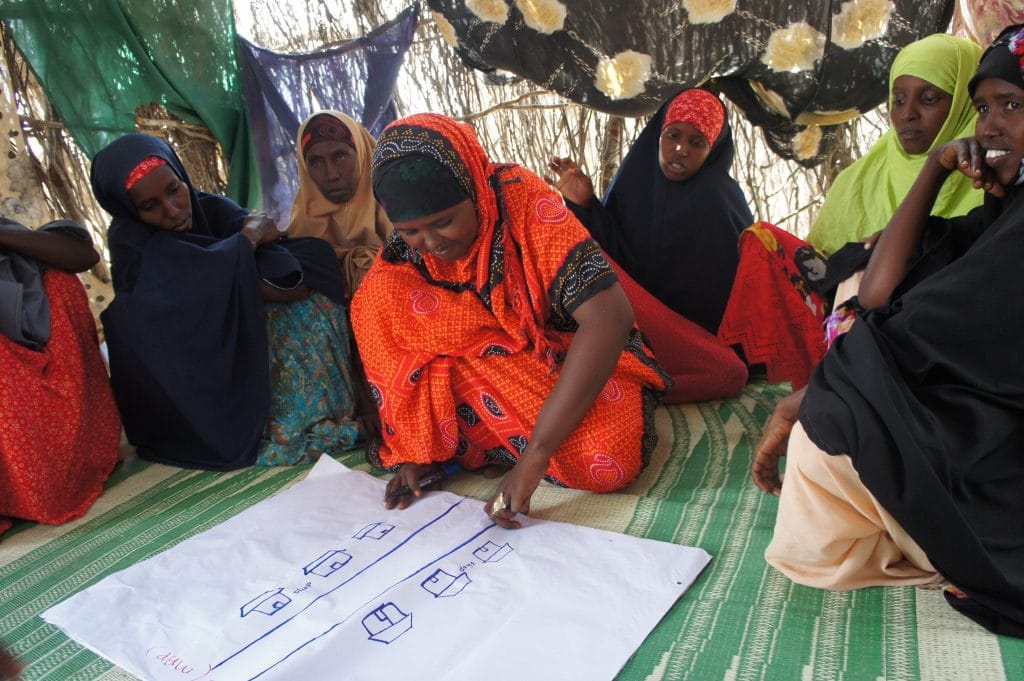
“Community-based” approaches do not work exclusively at the community level. CBA is a “community-led” process supporting a rights-based and forward-looking approach . This approach builds on communities’ economic, ecological, and administrative inter-connectivity to work at higher levels as appropriate.
In our climate action, we always take the rationale that when the poorest and most vulnerable – often women and girls and their communities in developing countries – are put at the center of solutions and are viewed as agents of change rather than as victims of climate impacts, adaptation can significantly reduce the risks from climate disruption.
Only by addressing the root causes of vulnerabilities, such as unequal power relations and access to decision-making, can vulnerable people identify and implement the adaptation solutions that serve their needs best.
Featured Content
Joint Principles for Adaptation
The Joint Principles for Adaptation (JPA) is a statement by civil society organizations from across the world, created under the Southern Voices on Adaptation Program, on what they consider to be a benchmark for good adaptation planning and implementation. It is a tool for ensuring that national policies and plans meet the needs and fulfill the rights of the most vulnerable people to adapt to climate change.
Adaptation Good Practice Checklist
The Adaptation Good Practice Checklist provides guidance on actions and criteria which help to ensure that adaptation results in quality, impactful and long-term climate resilience for the most vulnerable people.
CVCA Handbook
The Climate Vulnerability and Capacity Analysis (CVCA) is a tool used to gather and analyze information on community-level vulnerabilities to and capacities for climate change. It informs the identification of actions, at the community level or more broadly, that support communities in increasing their resilience to climate change.
Participatory Scenario Planning
Participatory Scenario Planning (PSP) is an approach that facilitates the collective interpretation of climate forecasts by bringing together diverse stakeholders—from meteorologists to community members—to inform decisions that support more resilient livelihoods and risk management, thereby strengthening the adaptive capacity of communities at most at risk. By placing local expertise on equal footing with scientific data, this process ensures that adaptation plans are coordinated across sectors and deeply responsive to the priorities of those most at risk.
Climate Information Services
Climate Information Services (CISs) is a key component of climate adaptation work. CISs involve the provision of climate information in a way that assists decision making by individuals and organizations, tht support users to anticipate and manage the risks of a changing and variable climate. CARE engages in a range of climate services work in Africa, Latin America and the Caribbean and Asia-Pacific, integrated within its programmes from Early Warning systems and Forecast-based early action to seasonal or longer term forecasts and advisories.
Community-Based Adaptation in Practice
This paper documents CARE’s current practice of Community-Based Adaptation (CBA) to climate change and shows how, increasingly, elements of the approach are evolving and being integrated into other development sectors. This synthesis of 16 CBA project examples from Africa, Asia, and Latin America and the Caribbean informs an ongoing process to update CARE’s various tools and approaches to CBA for practitioner use.